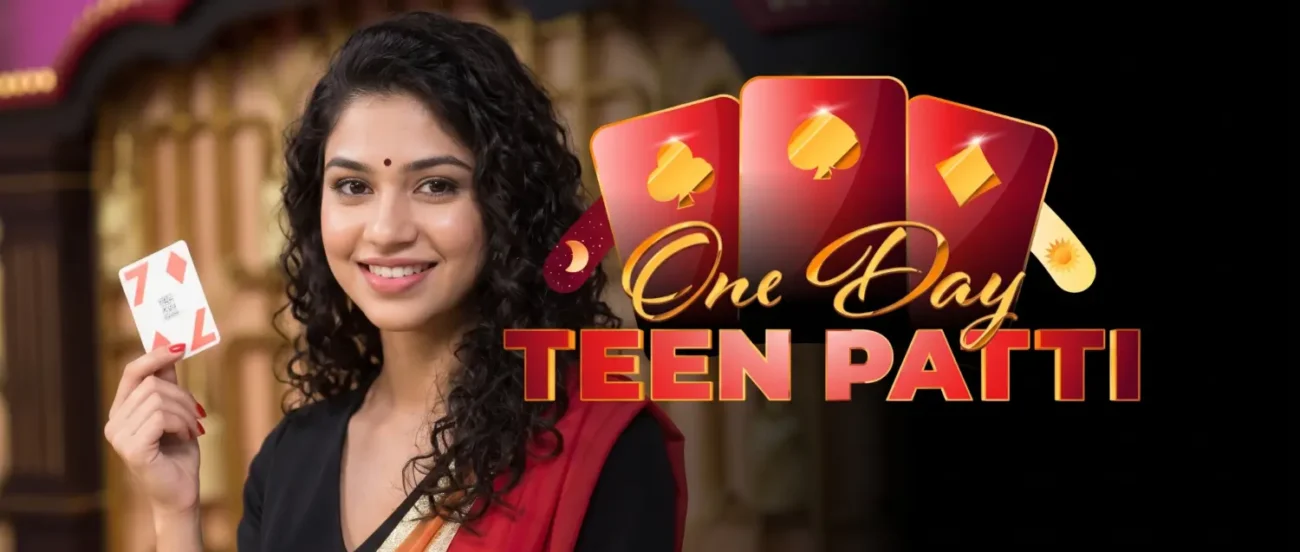
Five years on the market is a long time for a live dealer table game to still be getting fresh traffic, and One Day Teen Patti has managed it without ever picking up a sequel or a Power Reels-style spin-off. Ezugi launched it in mid-2021 as the third entry in its Teen Patti stable, built around a back-and-lay betting exchange mechanic that nobody else in South Asian live casino has properly copied since. That’s the first thing worth sitting with: in a market where Andar Bahar, Teen Patti and their variants get cloned within months, this one stood alone for five years. Either the mechanic is too fiddly to bother copying, or it’s genuinely hard to build. The 98.36% headline RTP and the fact that it still runs on a single, permanent table across most Ezugi-powered operators suggests the second explanation is closer to the truth. This review breaks down whether that complexity actually pays off for players in Bangladesh, India and Pakistan, or whether it’s a novelty that’s outstayed its welcome.
What kind of game this actually is
Before anything else: One Day Teen Patti is not a slot, and it doesn’t play like classic Teen Patti either. It’s a live dealer card exchange game. Two hands are dealt, Player A and Player B, three cards each, and you’re not playing either hand — you’re betting on which one wins, and you can change your mind after every single card. Think of it less as a casino game and more as an in-play sports market built around a card game, which is exactly how Ezugi’s own launch materials pitched it back in 2021.
Every round starts with roughly thirty seconds of open betting before any cards are dealt. At this stage the odds are fixed: 1.98 for a winning Back bet, 0.98 for a winning Lay bet, on either Player A or Player B. That’s the best price you’ll ever see in a round — a flat 1.98, no exceptions. After that first bet window closes, the dealer draws one card at a time, six cards total across both hands, and after every card the platform recalculates the odds based on which hand currently looks stronger. You get five separate opportunities to bet across the round, and you can back one player early and lay the other later, effectively hedging your own position as the picture becomes clearer.
That’s the mechanic in a sentence: you’re not predicting a poker hand once, you’re trading a live market on it five times per round. If that sounds more like an in-play football bet than a card game, that’s deliberate — Ezugi built this specifically to cross over with the sports betting crowd who already understand shifting odds and hedging.
The maths: RTP, house edge, and what the numbers actually mean at the table
The published theoretical RTP is 98.36%, which puts the house edge at 1.64% — and that figure applies specifically to the opening bet, placed before any cards are drawn. This is worth being precise about because most reviews quote 98.36% as if it’s a constant, and it isn’t. It’s the return if you only ever bet in that first thirty-second window and never touch the market again.
Once the first card lands, the maths changes completely. The platform recalculates odds after every card based on the current favourite, and by design those later odds offer worse value the more obvious the outcome becomes. If Player A pulls two strong cards and is sitting on a near-certain win, backing Player A on the fifth betting round might only pay out 1.05 or lower — technically correct given the reduced uncertainty, but nowhere near the 1.98 you’d have got by committing early. The dynamic pricing model means the house edge isn’t fixed at 1.64% throughout the round; it shifts round by round depending on how the dealer prices in-play risk, and no operator publishes a blended average RTP across all five betting windows. That’s a real gap in the public data, and if a figure isn’t published anywhere reputable, it doesn’t belong in this review as a fact — so treat the 98.36% as an opening-bet ceiling, not a session-long guarantee.
Put in practical terms: a $10 stake on the opening Back bet returns $19.80 if correct. The same $10 committed on the final card, once the outcome is nearly locked in, might return $10.50. You’re not getting worse odds because the game is rigged against late bettors — you’re getting worse odds because there’s genuinely less uncertainty left to price. That’s standard exchange-betting logic, and it’s the single hardest thing for a first-time player to internalise. Sports bettors will find it familiar. Slot and Teen Patti veterans who’ve never touched a betting exchange will find it genuinely disorientating the first few sessions.
Hit frequency isn’t really the right lens for this game — there’s no scatter or bonus trigger to hit. What matters instead is decision frequency: five live pricing windows per round, each one lasting only a few seconds once the card lands, which means the whole round moves fast. Rounds run in the range of two to three minutes including the initial betting window, based on how the dealer paces card draws — quicker than a full hand of live Teen Patti, slower than a single Andar Bahar reveal.
There’s a genuine strategic layer here that most Teen Patti variants simply don’t have. Because you can hold a Back position on one hand and later place a Lay position on the same hand, you can lock in a guaranteed profit mid-round regardless of the final outcome — the same “greening up” technique used on betting exchanges for horse racing and football. Say you Backed Player A for $10 at 1.98 in the opening window. If Player A then draws two strong cards and the price to Back Player A collapses to 1.20, you can Lay Player A for roughly $16.50 at that price. Win or lose, the two positions net out to a small locked-in profit either way. It’s a genuinely clever piece of design once you understand it, and it’s also exactly the kind of thing that takes several real-money sessions — or, better, several demo sessions — to get comfortable executing under a five-second countdown.
Table limits, deck handling, and the studio
Stakes run from $1 to $1,000 per bet, which is a wide enough range to cover a casual $1 tester and a serious high-stake exchange trader on the same table — there’s no separate high-limit room for this title on most operators. The game uses one standard 52-card deck, and the dealer swaps to a fresh, machine-shuffled deck at the start of every round rather than reshuffling the same deck repeatedly. That’s a small but genuinely reassuring detail for players worried about pattern-tracking or dealer fatigue affecting shuffle randomness.
One Day Teen Patti streams from Ezugi’s studio in Romania, the same flagship location that hosts the bulk of Ezugi’s card-game catalogue. Ezugi itself was founded in Sofia in 2012 and has been part of the Evolution Group since 2018 — worth knowing because Evolution now also lists this title directly on its own game library under the live poker category, which tells you the parent company sees it as a keeper rather than a legacy product being quietly retired.
A beginner’s walkthrough: what actually happens in a round
Because the pricing logic is the hardest part to grasp from a written description alone, it’s worth walking through a single round step by step, the way a first-timer would actually experience it.
The round opens. You see two empty hands, Player A and Player B, and a thirty-second countdown. The price for a Back bet on either side is 1.98; the price for a Lay bet is 0.98. You decide, say, to Back Player A for $5. That bet is locked in — this is the only bet you’ll place all round if you choose not to come back in later.
The timer runs out. The dealer draws the first card and gives it to Player A. Say it’s a King. The system recalculates: Player A now looks marginally stronger, so the price to Back Player A drops — maybe to 1.70 — and the price to Lay Player A rises correspondingly. You get a few seconds to act. You could Back Player A again at the new, worse price to increase your stake on a strengthening hand, Lay Player A to hedge part of your original bet, or do nothing and let your original $5 position ride.
This repeats for the next card, dealt to Player B, then alternates until all six cards are down — three per hand — and the two three-card hands are compared using standard hand rankings, high card up to the top hand (Ace-King-Queen suited). Whichever hand ranks higher wins the round, and every open Back or Lay position pays out at whatever price it was struck at, not the final price.
The mistake almost every new player makes in their first few sessions is treating each of the five windows as a fresh, independent bet at similar value to the first. It isn’t. The first window is the only one with a genuinely fixed, favourable price. Every window after that is pricing in information you’ve already partly seen unfold on screen, and the platform is not going to hand out 1.98 twice.
Breaking down the actual features
Back and Lay betting
This is the core mechanic and the reason the whole game exists. A Back bet predicts a hand will win; a Lay bet predicts it will lose. You can hold both positions across a round — back Player A early, then lay Player A later if the cards start turning against your original read, effectively closing out your risk rather than riding a losing position to the end. The catch: you need to understand why the price moved, not just that it moved. A hand can look weak on paper (low cards, no pair) and still be priced as a slim favourite if the remaining deck composition favours it improving. This isn’t decoration for atmosphere — it directly changes what a rational bet looks like on card three versus card five, and it’s the single feature that separates this game from every other Teen Patti variant on the market.
The five betting windows
Six cards, five pricing windows: one before any cards are dealt, then one after each of the next five cards. Each window lasts only as long as the operator’s UI keeps it open, typically a handful of seconds once the card is revealed. You don’t have to bet in every window — you can sit out three windows and only jump in once, or you can bet in all five and build up a stack of positions. The realistic payout contribution here skews heavily toward the opening window: that’s where the 1.98 flat price lives, and it’s the only window with genuinely fixed, published odds. Every window after that is a shrinking-value proposition dressed up as more chances to play.
Statistics roadmap (last 100 rounds)
A results tracker sits on the interface showing outcomes from the previous 100 rounds, including win splits between Player A and Player B. It’s a nice touch for players who like to spot streaks, and it genuinely helps with orientation in a game that otherwise throws a lot of shifting numbers at you fast. The honest catch, and it applies to every “last 100 rounds” tracker on every card or dice game ever built: each round uses a freshly shuffled deck. Nothing about round 99 has any bearing on round 100. Treat the roadmap as a pacing tool, not a prediction tool.
Autobet
A customisable autobet feature lets you set a stake and repeat it automatically across future rounds without manually re-entering it each time. Useful for players who’ve settled on a strategy and don’t want the friction of retyping a stake five times a round, less useful for anyone still learning how the odds shift, since it removes the moment where you’d normally stop and reconsider your read on the hand.
No side bets — and that’s a real gap
Unlike Ezugi’s standard Teen Patti table, which carries a Pair Plus side bet (95.51% RTP) and a 3+3 Bonus side bet (91.44% RTP), One Day Teen Patti ships with zero side betting options. Several independent reviewers have flagged this as a missed opportunity rather than a deliberate simplicity choice — the back-and-lay structure would arguably support a side market on, say, whether a tie occurs, and Ezugi simply never built one. If you’re the type of player who came to Teen Patti for the bonus-bet variance, this table won’t scratch that itch.
The 2026 perspective: where this sits in the family, and against the competition
Ezugi’s Teen Patti portfolio is really three separate games wearing the same name, and mixing them up is the single most common mistake new players make. Teen Patti (the original, 2019) is a straight player-versus-dealer three-card poker game with an Ante/Play structure, a 96.63% RTP on the main bet, and two side bets — Pair Plus at 95.51% and a 3+3 Bonus at 91.44%. Bet on Teen Patti (also known as “20-20 Teen Patti”) drops the dealer entirely and has you predict which of two player hands wins, similar in spirit to One Day Teen Patti but with a single fixed bet placed before any cards are dealt, no in-play repricing, and its own Pair Plus and 3+3 side bets, running at a 97.39% RTP on the main market. One Day Teen Patti takes that two-hand structure and adds the in-play exchange layer on top — no side bets, no dealer hand, but five pricing windows instead of one.
None of these three is a strict upgrade on the others, and that’s worth being direct about, because it isn’t how most game families work. A slot sequel usually improves the math model outright. Here, the highest headline RTP belongs to One Day Teen Patti at 98.36%, but that figure only applies to a single betting window out of five, and the game with the next-highest RTP — Bet on Teen Patti at 97.39% — gives you that number on every single bet, plus two side markets Ezugi never bothered building for the newer title. If raw, dependable RTP is what you’re optimising for, Bet on Teen Patti is arguably the sharper pick despite being the less flashy release.
Against the wider live-dealer market, the direct competitor set is thin, because almost nobody else runs a Teen Patti exchange product. Evolution’s own Andar Bahar — the game Ezugi itself pioneered live back in 2018 before Evolution’s 2018 acquisition folded the studio in — remains the reference point for South Asian card betting simplicity: two outcomes, near 50/50, fast resolution, no repricing to learn. It’s a fundamentally easier product for a first-time Tier 3 player to trust because there’s nothing to misread. Evolution’s Super Andar Bahar adds a side-bet layer for players who want more variance without the exchange complexity. Neither offers anything close to the strategic depth One Day Teen Patti gives an engaged player, but neither demands it either — and for a lot of casual mobile players in Bangladesh, Pakistan and India betting small stakes between other things, that simplicity wins more sessions than depth does.
There’s no buy-bonus mechanic here, and there’s no progressive jackpot — neither concept transfers to a live exchange-betting card game, so their absence isn’t a mark against it the way it would be on a 2026 slot release. What actually matters for a 2026 verdict is whether the in-play repricing model still feels current, and it does. If anything, the growing popularity of in-play sports betting across South Asian mobile platforms makes the crossover appeal of this title stronger now than it was at launch in 2021 — players who already bet live on cricket matches will recognise the shifting-price logic instantly.
Outside Ezugi’s own stable, the closest thing to direct competition is Evolution’s in-house Teen Patti table, which runs the traditional player-versus-dealer format under the same corporate umbrella now that Ezugi and Evolution share a parent company, and Playtech’s Teen Patti, which uses rules closer to land-based three-card poker than the Ezugi version. Neither Evolution nor Playtech has built anything resembling the back-and-lay exchange model — as of 2026, that mechanic remains uniquely Ezugi’s, which is either a sign of a durable competitive moat or a sign that the rest of the market looked at it and decided the added complexity wasn’t worth the development cost. Five years without a copycat leans toward the latter, but the fact that Evolution kept the game live on its own flagship game library rather than quietly retiring it leans toward the former.
A free demo version is available on several operator platforms and Ezugi-powered demo aggregators, letting you run through a full round with the back-and-lay mechanic before staking real money — genuinely worth doing at least three or four rounds through, given how different the pricing logic is from anything in standard Teen Patti or Andar Bahar.
So: is this a high roller’s game, a recreational game, or dead weight in a 2026 lobby? It’s neither purely high roller nor purely recreational — it’s a specialist’s game wearing recreational stakes. The $1 minimum lets anyone in, but the mechanic rewards exactly the kind of player who wouldn’t normally sit at a $1 table: someone who reads odds for a living or treats poker hand equity as second nature. It’s not dead weight, but it’s not a mass-market pick either. It occupies a narrow, genuinely useful niche between live casino and sports betting that nothing else on the Ezugi menu fills.
Verdict
One Day Teen Patti is worth your time if you already think in odds — sports bettors used to in-play cricket or football markets, and poker players comfortable reading hand equity on the fly, will get real value out of the five-window repricing structure and the low $1 entry point. The one number that limits it: that 98.36% RTP is an opening-bet-only figure, and there’s no published blended rate across all five betting windows, which means you’re taking Ezugi’s word for the value of every bet placed after the first card. For that player profile, this is a genuinely distinctive live-casino product, and the fact that nobody’s cloned the mechanic in five years says it’s harder to build well than it looks.
It’s not for players who came to Teen Patti wanting the classic dealer-versus-player format, side bets, or a game that can be understood just by watching for thirty seconds — those players should go straight to Ezugi’s original Teen Patti table (96.63% main RTP, two side bets) or Bet on Teen Patti (97.39% flat RTP, also with side bets), both of which are simpler and, on a per-bet basis, arguably better value than One Day Teen Patti’s post-opening pricing. Casual mobile players chasing a quick, low-friction card game are better served by Andar Bahar. Run the free demo first regardless of which camp you’re in — the back-and-lay logic genuinely doesn’t click until you’ve watched the price move against your position at least once.
FAQ
Is One Day Teen Patti a slot game? No. It’s a live dealer card game built around a back-and-lay betting exchange, not a reel-based slot. Some listings incorrectly file it under “slots” — it plays nothing like one.
What’s the minimum and maximum bet? Stakes run from $1 to $1,000 per individual bet, across a single shared table.
Can I play a free demo before staking real money? Yes. A no-registration demo version is available through several Ezugi-powered operator platforms and demo aggregators, letting you run full practice rounds with the back-and-lay mechanic.
Are there side bets like in standard Teen Patti? No. One Day Teen Patti has no side betting markets, unlike Ezugi’s original Teen Patti (Pair Plus, 3+3 Bonus) and Bet on Teen Patti, which both carry side bets.
What happens if the two hands tie? Ties are technically possible in the underlying card mechanics, though rare, and none of the reviewed sources publish a confirmed payout rule for a tied round — treat this as unconfirmed rather than assume your stake is automatically returned.
Is this game popular in Bangladesh, India and Pakistan? Teen Patti as a format is deeply rooted across South Asia, and Ezugi built dedicated Hindi-speaking dealer rooms and India-focused card products well before most competitors did. One Day Teen Patti specifically appeals more to players already comfortable with in-play sports betting odds than to Teen Patti purists.
