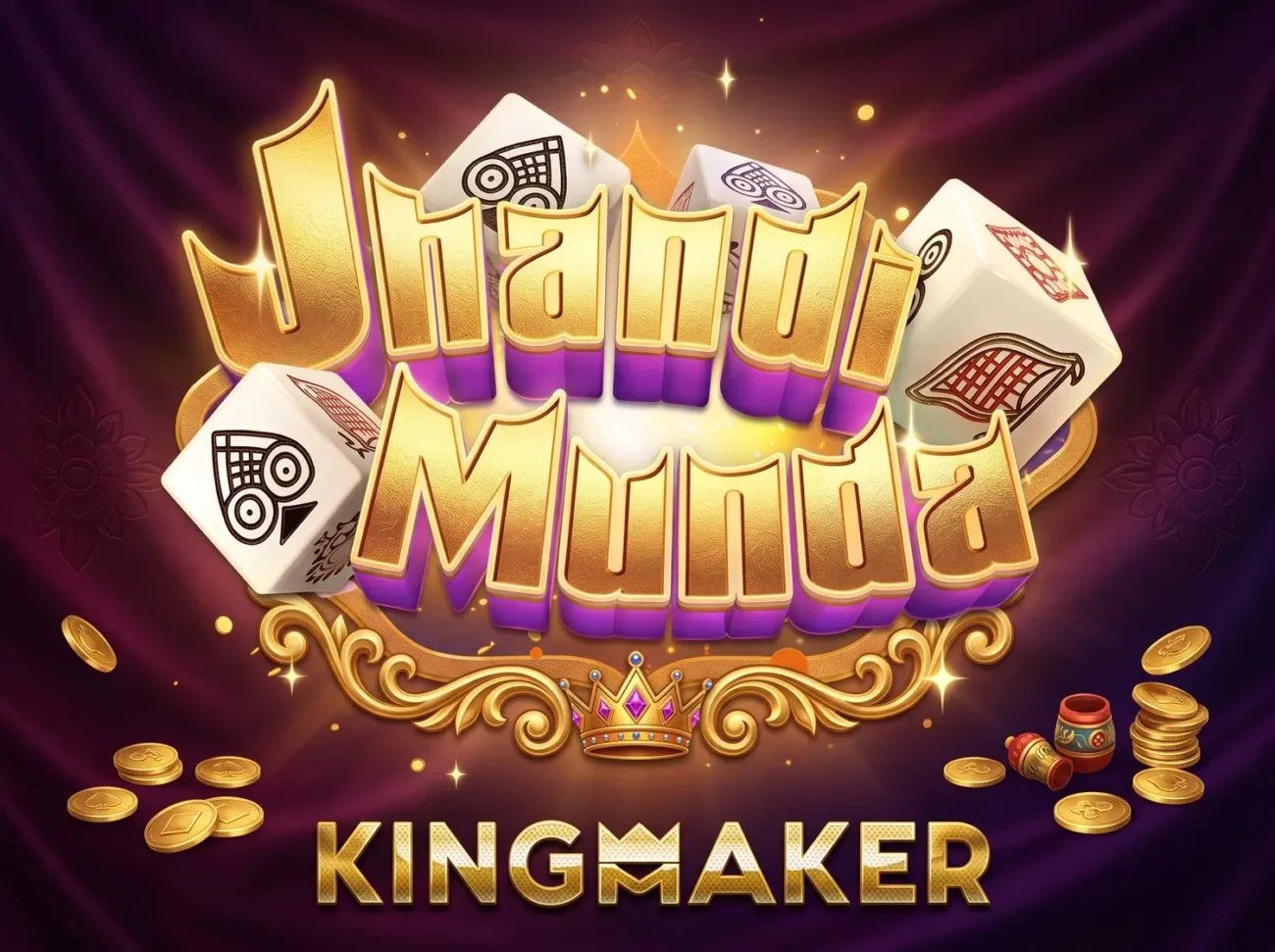
Jhandi Munda has been rolling around Indian festivals for generations before anyone put it behind a login screen. Kingmaker’s digital version has been sitting quietly in the live and RNG table game lobbies of casinos serving Bangladesh, India, and Pakistan for a few years now, mostly unbothered by the marketing budgets that get thrown at slots and crash games. It doesn’t have a sequel, a Megaways badge, or a jackpot ticker. What it has is a 97% RTP, six dice, and a betting structure that hasn’t changed since it was played on a mat at a village fair.
The question worth asking in 2026 isn’t whether Jhandi Munda is fun — it clearly still is, given how many operators keep it in rotation. The question is whether Kingmaker’s specific build of it holds up against the dice games players in this region can now choose from, including versions of the exact same game built by other studios. That comparison is more interesting than it sounds.
The maths behind the dice
Kingmaker’s Jhandi Munda runs at 97% RTP, according to third-party game guides that describe the Kingmaker build specifically. That figure needs a flag attached to it: one operator’s game page for this title lists 99% RTP, but that number sits inside a templated widget used across dozens of unrelated games on the same site, with blank provider and game-name fields either side of it. It reads like a placeholder rather than a verified figure. Until Kingmaker publishes its own certified number, 97% is the more credible figure to plan around.
Here’s where it gets genuinely confusing: there is more than one online “Jhandi Munda.” TaDa Gaming released its own version of the same game in October 2024, running at 96% RTP with a 200x max win. Other studios — Mplayh, TopSpin — have their own builds too, with RTPs anywhere from 92% to 97% depending on which aggregator you read. None of these are Kingmaker’s game. If you’re comparing notes with a friend on a different casino, check the provider name before you assume you’re talking about the same title.
Jhandi Munda doesn’t have volatility ratings the way a slot does, because there’s no reel to spin and no bonus round sitting behind a scatter trigger. What it has instead is bet frequency built into the maths of six dice. You’re betting on how many of the six dice land on your chosen symbol — heart, spade, diamond, club, crown, or flag. Because there are only six symbols spread across six dice, hitting at least one match on your chosen symbol happens often. Hitting four, five, or all six of them on a single roll does not.
That’s the honest volatility profile here: frequent small wins from single and double matches, with the bigger multipliers reserved for outcomes that get rarer fast. A six-dice match on one symbol, out of six possible symbols, isn’t something you should expect to see more than a handful of times in a long session. Betting rooms are split into tiers — reports describe Casual, Novice, and Expert stakes, with a fourth tier mentioned but not clearly named in the sources available. The minimum bet sits around ₹10 to ₹20 depending on the operator; a confirmed maximum bet from Kingmaker directly wasn’t available, so it isn’t stated here rather than guessed at.
Each round moves fast. Players get roughly 20 seconds to place bets before the dice roll, which is closer to a live game show cadence than a slot’s spin-and-wait rhythm. That pace is part of the appeal for players who find slots too slow and sportsbook markets too complicated — you place a bet, you watch six dice land, you know the result in under half a minute.
You might ask: why does a 1-point RTP gap between Kingmaker’s 97% and TaDa Gaming’s 96% actually matter? Over a long session, it’s the difference between a house edge of 3% and 4% — meaningful if you’re grinding the same stake for hours, close to irrelevant if you’re playing a few rounds during a cricket match break. Context decides how much this number should worry you.
Put it in real numbers. If you bet ₹100 per round on Kingmaker’s Jhandi Munda over a long enough stretch of play — say, several hundred rounds — the 97% RTP means you’d expect roughly ₹97 back for every ₹100 wagered on average. That’s not a guarantee for any single session; it’s a long-run average built from thousands of rolls, and a bad hour will feel nothing like it. On TaDa Gaming’s version at 96%, the same ₹100 average return drops to roughly ₹96. A single rupee per hundred sounds small until you’re three hours into a session and the dice haven’t been kind.
Why does hitting all six dice happen so rarely? Six independent dice, six equally likely symbols on each one. Landing your chosen symbol on any single die is roughly a 1-in-6 shot. Landing it on all six simultaneously means that 1-in-6 chance repeating six times in the same roll — the odds stack against you fast, which is exactly why the payout climbs from 1:1 to 6:1 as the match count rises. This isn’t a hidden mechanic Kingmaker is keeping quiet about; it’s the same maths that governs any dice game, from Sic Bo to a bar dice hustle. Understanding it is the difference between betting with your eyes open and betting on vibes.
How a round actually plays out
For anyone who hasn’t sat at a Jhandi Munda table before — live or RNG — the round structure is worth walking through once:
- The table opens. A betting window of roughly 20 seconds appears, showing all six symbols: heart, spade, diamond, club, crown, and flag.
- You place your bet. You can back a single symbol or spread stakes across several. Betting on more symbols raises your chance of some return but spreads your stake thinner across the payout table.
- The window closes. No more bets accepted once the timer runs out — there’s no adjusting your position after this point, unlike a crash game where you can cash out mid-round.
- Six dice roll. Simultaneously, not one at a time, so there’s no build-up the way a slot’s cascading reels create tension.
- Payouts settle. Each symbol you backed is paid according to how many of the six dice landed on it, using the 1:1 through 6:1 table above. If the bonus symbol landed on a winning bet, the multiplier applies before the payout is credited.
That’s the entire loop, and it repeats in well under a minute per round. Compare that to a slot’s base game plus feature round, and Jhandi Munda is closer to roulette in pacing than anything reel-based.
What the game actually does — feature by feature
The core bet: matching symbols
This is the entire skeleton of Jhandi Munda, and it’s worth explaining properly because it’s doing more work than a single “feature” in a slot ever does. Six dice roll. You bet on one or more of the six symbols before the roll. Payouts scale with how many dice land on your chosen symbol:
- One matching die pays 1:1
- Two matching dice pay 2:1
- Three matching dice pay 3:1
- Four matching dice pay 4:1
- Five matching dice pay 5:1
- All six matching dice pay 6:1
That’s a linear payout table, not an exponential one. A slot with a “6x” top multiplier on its base game would be considered flat and unremarkable. Here, 6:1 is the actual ceiling of the core bet — and it’s genuinely rare, because it requires all six independent dice to land the same symbol out of six options.
The honest limitation: this payout structure rewards volume betting across multiple symbols more than it rewards patience on a single one. Spread ₹60 across all six symbols and you’re guaranteed some return on almost every roll, because six dice landing on zero of six symbols is close to impossible — you’re just trading away any chance of the bigger 4:1 to 6:1 payouts in exchange for smoother, smaller returns. Concentrate that same ₹60 on one symbol and you’ll see longer dry spells punctuated by the occasional 3:1 or 4:1 hit. Neither approach is wrong; they’re just different bets on the same underlying maths, and it’s worth deciding which one you actually want before you sit down.
Players chasing “hot” and “cold” symbol patterns are, in practical terms, applying a narrative to independent dice rolls that don’t carry memory between rounds. Six new dice, six new probabilities, every single time. It’s a comforting story, and I understand the appeal of it after watching a symbol repeat three rounds running — but the dice don’t know what they did last round, and neither does the RNG behind them.
The 2x bonus symbol
Kingmaker’s one genuine point of difference from a bare-bones dice table is a bonus symbol that can land on the betting table alongside the roll. When it lines up with a symbol you’ve bet on and that bet wins, your payout gets doubled. Multiple sources describe this bonus stacking up to a 12x total multiplier on a winning bet, though the exact frequency of the bonus symbol appearing, and how many times it can stack per round, isn’t documented anywhere verifiable.
That’s worth sitting with for a second. A 12x ceiling sounds respectable next to a 6:1 base payout table. It is not respectable next to what dice games from bigger studios are doing with the same core concept in 2026 — more on that below. The bonus symbol is a genuine feature, not marketing fluff, but it’s a modest one layered onto an otherwise very old game design.
What’s missing from the public documentation is the part that would actually let a player weigh this properly: how often the bonus symbol shows up. Slots typically publish a feature frequency, even a rough one — one bonus round per X spins on average. Nothing equivalent exists for Kingmaker’s bonus symbol in any source available at the time of writing. That’s not a fabricated concern; it’s a genuine gap. Until Kingmaker or a licensed testing lab publishes that figure, treat the 12x ceiling as a maximum you might see occasionally, not a number that tells you anything about how often the feature triggers.
Betting rooms and stakes
The game is split across multiple stake tiers — Casual, Novice, and Expert have been named in game guides, with a fourth tier referenced but not clearly identified. This is a sensible structure for a Tier 3 audience: a player testing the game with a ₹10 minimum bet in the Casual room isn’t sitting at the same table as someone running Expert-room stakes. What isn’t available is a confirmed table of exact bet caps per room from Kingmaker itself, so treat the room names as a real feature of the game and the specific limits as something to check on the casino’s live table before you sit down.
Where this leaves Jhandi Munda in a 2026 lobby
Kingmaker’s Jhandi Munda has no sequel. There’s no Power Reels edition, no Megaways rebrand, no “2.0” version with an expanded feature set. What you see is what’s existed for years — which is either refreshingly honest or a sign that Kingmaker hasn’t touched this title’s mechanics in a while, depending on how charitably you want to read it.
The more useful comparison isn’t a sequel that doesn’t exist — it’s what else is sitting in the dice-game category of the same lobbies. TaDa Gaming’s own Jhandi Munda, released in October 2024, runs 96% RTP with a 200x max win figure attached to it. That 200x number needs context: it’s describing a different payout structure than Kingmaker’s linear 6:1 table, likely built around multiplier symbols rather than pure dice-matching, so it isn’t a clean like-for-like swap. Still, a player choosing between the two purely on stated ceiling is choosing 200x over 12x, and that gap is hard to ignore.
Zoom out further and the comparison gets less comfortable for Kingmaker. Evolution’s Super Sic Bo — a different dice game, same broad category — layers random multipliers onto classic Sic Bo betting spots that can push payouts up to 1,000x. Ezugi’s standard live Sic Bo, running the classic three-dice format without the multiplier layer, sits around 97% RTP on its most common Small/Big bets, putting it neck and neck with Kingmaker’s headline number while offering a betting menu with more than 30 wager types instead of six symbols. Neither of these is a Jhandi Munda clone, but they’re both proof that dice games in 2026 don’t have to cap out at 12x to stay simple.
Laid out side by side, the gap is easier to see:
| Game | Provider | RTP | Max win | Core mechanic |
|---|---|---|---|---|
| Jhandi Munda | Kingmaker | 97% | 12x (bonus symbol) | Six dice, symbol match count, 1:1–6:1 base table |
| Jhandi Munda | TaDa Gaming | 96% | 200x | Six dice, same theme, different payout structure |
| Sic Bo | Ezugi | ~97% (Small/Big) | Varies by bet type | Three dice, 30+ bet types, no multiplier layer |
| Super Sic Bo | Evolution | Not confirmed here | 1,000x | Three dice, random multiplier spots pre-roll |
Read that table honestly and Kingmaker’s Jhandi Munda is the most conservative option on it by a wide margin. Its RTP holds up fine. Its ceiling doesn’t. A player who wants the cultural authenticity of Jhandi Munda specifically, rather than dice games generally, doesn’t have many other Kingmaker-shaped options — but a player who’s dice-agnostic and just wants variance has clearly better-paying tables sitting in the same lobby.
There’s no buy-bonus mechanic here — you can’t pay to skip into the bonus symbol the way you can pay for a bonus round on a modern slot. There’s no progressive jackpot sitting on top of the payout table either. For a game this stripped-back, that absence isn’t really a black mark; it’s consistent with what Jhandi Munda has always been. But it does mean the game is competing against titles that offer meaningfully more upside for a similar or lower house edge, and it’s not currently doing anything to close that gap.
Kingmaker’s broader catalogue leans heavily into localised RNG table and dice games built for Asian markets specifically — Jhandi Munda sits alongside a long list of regional card and dice titles rather than a handful of headline slots. That’s a studio strategy, not a criticism: Kingmaker is clearly building depth in a category most Western-facing providers ignore. Jhandi Munda benefits from that focus in terms of cultural authenticity — the symbols, the table layout, the pacing are all built for players who already know this game from outside a casino. It just doesn’t benefit from it in terms of mechanical ambition.
So is this a high roller’s game, a recreational one, or dead weight in a 2026 lobby? It’s recreational, and there’s no shame in that. The 20-second round pace and low ₹10 entry point make it a genuinely good fit for short sessions and small stakes. It is not built for anyone chasing a life-changing multiplier — that player has better options two rows down in the same lobby.
Playing it from Bangladesh, India, or Pakistan
None of the sources checked for this piece confirmed which specific Bangladesh-, India-, or Pakistan-facing casino brands carry Kingmaker’s build of Jhandi Munda by name — India-facing operators 7Cric and 10Cric both list it directly under Kingmaker’s provider tag, which is the clearest confirmation available. If you’re checking a Bangladesh- or Pakistan-facing site, look for the Kingmaker provider filter in the table games or live casino lobby rather than searching “Jhandi Munda” alone, given how many differently-built versions share that name.
The game itself travels well across all three markets without much adaptation needed. It’s mobile-first by default — the table interface is simple enough that it doesn’t strain a mid-range Android screen or chew through mobile data the way a graphics-heavy slot does. The 20-second betting window and sub-minute round time make it a realistic option for the kind of short, phone-in-hand sessions that dominate play in this region: a few rounds between overs during a cricket match, or a quick session on a commute.
Currency and payment rails aren’t a Kingmaker-specific concern — they depend on which casino you’re playing through — but the low entry point matters here specifically. A ₹10 to ₹20 minimum bet (or the equivalent in BDT or PKR, depending on the operator’s currency conversion) keeps this accessible to players testing the game for the first time, which fits a Tier 3 market where minimum deposit and stake size are often bigger decision factors than any feature on the paytable.
Verdict: play or skip?
Play it if you already know Jhandi Munda from outside a casino and want a fast, low-stake way to bet on something familiar during a short session. The 97% RTP is competitive for a table game in this category, the round pace suits mobile play on a patchy connection, and the linear payout table is easy to understand without reading a rules page first — genuinely rare for a betting game.
Skip it if you’re after ceiling. 12x is the one number that limits this game, and it’s a hard limit to argue around once you know Evolution’s Super Sic Bo is sitting in a comparable lobby offering roughly 80 times that multiplier on the same basic concept of predicting dice. Players chasing big multipliers, or anyone who wants a feature set beyond a single bonus symbol, will find more here to be frustrated by than excited about.
The player profile this suits: someone who wants a quick, understandable, low-cost dice bet between other games — not someone building a session around chasing the top of the paytable.
Here’s the practical takeaway I’d give a friend asking whether to bother: treat Kingmaker’s Jhandi Munda as a snack, not a meal. Play it in short bursts, at the Casual or Novice stakes, when you want something familiar and fast between bigger sessions on other tables. Don’t treat the bonus symbol as a reason to chase — with no published trigger frequency and a 12x cap, it’s a nice surprise when it lands, not a strategy to build a bankroll around. If your actual goal is variance and a shot at a big multiplier from a dice roll, Evolution’s Super Sic Bo is sitting in the same lobby doing that job far better.
FAQ
Is Jhandi Munda by Kingmaker the same game as Jhandi Munda by TaDa Gaming? No. They share a name and the same six-dice, six-symbol concept, but they’re built by different studios with different payout tables and different RTPs — 97% for Kingmaker’s version against 96% for TaDa Gaming’s. Check the provider name on the game tile before assuming you’re playing the same build.
What is the minimum bet on Jhandi Munda by Kingmaker? Reported minimum bets sit around ₹10 to ₹20 depending on the operator and betting room. A confirmed maximum bet directly from Kingmaker wasn’t available at the time of writing.
Does Jhandi Munda by Kingmaker have a jackpot or bonus buy? No. There’s no progressive jackpot and no option to pay for direct access to the bonus symbol feature. The only multiplier mechanic is the 2x bonus symbol, which can stack up to a reported 12x on a winning bet.
Why do different sites list different RTP figures for Jhandi Munda? Because “Jhandi Munda” is a generic game name used by several different studios — Kingmaker, TaDa Gaming, Mplayh, and TopSpin all have their own versions with different math models. A single RTP figure claimed for “Jhandi Munda” without naming the provider should be treated with caution.
Is Jhandi Munda by Kingmaker suitable for beginners? Yes. The rules are close to betting on a coin toss with more options: pick a symbol, watch six dice land, get paid based on how many matched. There’s no paytable to memorise beyond the six payout tiers listed above.
Can I use hot and cold symbol tracking to improve my odds? Not really. Each roll uses six fresh, independent dice, so a symbol that’s appeared often in recent rounds is no more or less likely to appear again. Tracking hot and cold symbols can make a session feel more structured, but it doesn’t change the underlying probability of any given roll.
